Our website features a wide range of lowbed trailers from different brands, models, and load capacities, making it easy for you to compare various options in one place.
Whether you are looking for a 2 axle, 3 axle, 4 axle, or multi axle lowbed trailer, we provide different configurations to meet your transportation requirements. You can browse our website to check reference prices, compare specifications, and learn more about the advantages of each model.
If you cannot find the exact lowbed trailer you need, please feel free to contact us. Our sales team will provide detailed quotations, product specifications, and customized solutions based on your requirements, helping you choose the right lowbed trailer at a competitive price.
The lowbed trailer price in Nigeria is not determined by a single factor; rather, it is influenced by a combination of elements, including load capacity, number of axles, frame structure, steel specifications, hydraulic systems, axle and suspension configurations, tire setups, braking systems, customization requirements, and the specific terms of transport and trade. For customers in different countries and regions, even when purchasing the same type of lowbed trailer, the final model selected—and its corresponding price—can vary significantly due to differences in equipment weight and dimensions, local road regulations, operating environments, and budgetary constraints. Therefore, when purchasing a lowbed trailer, one should not rely solely on the quoted price; instead, a comprehensive evaluation is necessary, taking into account actual transport requirements, vehicle configuration, manufacturing quality, and long-term operating costs.
1. Load Capacity and Number of Axles
Load capacity is a primary factor in determining the lowbed trailer price in Nigeria. Trailers with different load ratings typically differ in terms of frame structure, steel thickness, number of axles, tire configuration, and suspension systems. For instance, a 30–40 ton capacity lowbed trailer often used for transporting small-to-medium-sized excavators, loaders, forklifts, and other construction machinery, features a relatively simple structure and fewer load bearing components, resulting in a lower manufacturing cost compared to a heavy duty model from the same brand with similar specifications. Conversely, customers needing to transport large excavators, mining equipment, bulldozers, or other heavy duty machinery may require a trailer with a capacity of 60, 80, 100, or even 120+ tons. Such models necessitate stronger main beams, an optimized load-distribution design, and higher capacity axles and tires, all of which lead to higher overall manufacturing costs.
2. Frame Structure and Steel Specifications
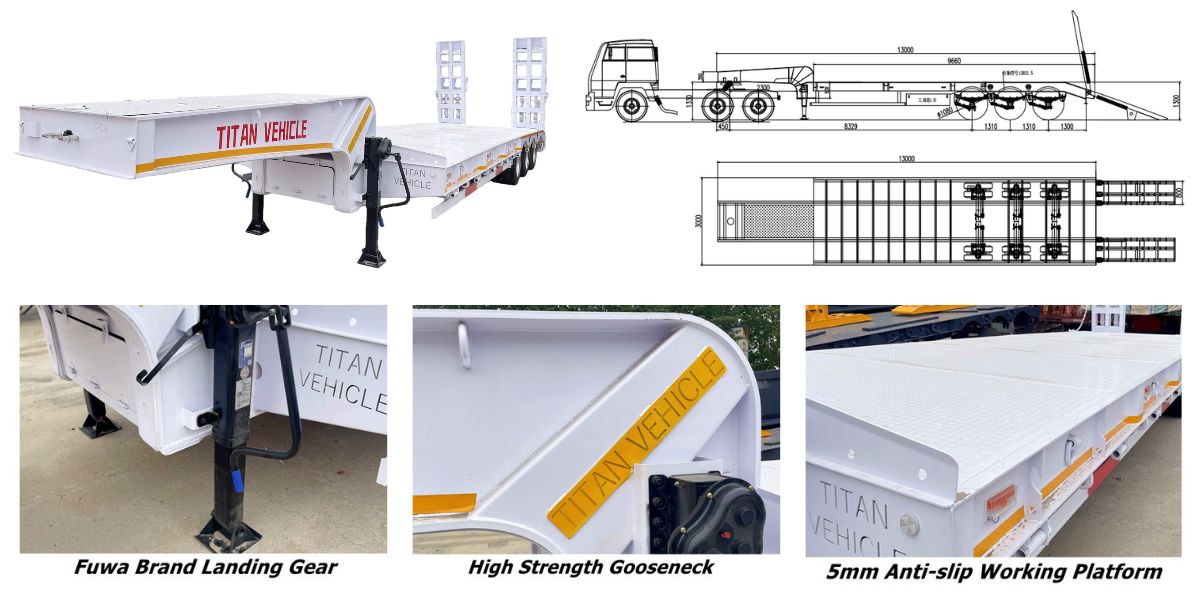
The frame serves as the primary load bearing structure of a lowbed trailer. Its design, the quality of the steel used, the thickness of the steel plates, and the manufacturing processes employed all directly influence the final lowbed trailer price in Nigeria. Lowbed trailer typically subjected to concentrated loads from construction machinery. Consequently, the main beams, cross-members, the connection area at the gooseneck, and the suspension mounting points must be carefully engineered based on the anticipated actual loads. For standard construction machinery transport, a conventional structural design is generally sufficient. However, for clients who frequently transport large excavators, mining equipment, or other heavy duty machinery, it may be necessary to incorporate reinforced main beams, an optimized cross member layout, and localized structural reinforcements to enhance the frame’s load bearing capacity and fatigue resistance. These design choices influence steel consumption, labor hours, welding complexity, and overall manufacturing costs. Therefore, even if two lowbed trailers appear identical in terms of exterior, length, and number of axles, lowbed trailer price in Nigeria can differ significantly based on their specific frame structure and design load capacity.
The type and thickness of the steel used are also critical factors affecting the lowbed trailer price in Nigeria. Different grades of steel offer varying levels of strength, toughness, and workability; utilizing high strength steel that meets specific design requirements helps optimize the frame's weight while maintaining the necessary load-bearing capacity.
3. Gooseneck Configuration and Loading/Unloading Methods
The design of the gooseneck is another major factor that determines the lowbed trailer price in Nigeria. Depending on transport requirements, these trailers can be configured with a fixed gooseneck, a mechanically detachable gooseneck, or a hydraulically detachable gooseneck. A fixed gooseneck features a relatively simple structure with fewer components, generally resulting in lower manufacturing costs and easier maintenance; it is well-suited for operations with consistent transport routines where there are no specific requirements regarding loading/unloading height. A mechanically detachable gooseneck, by contrast, allows the connection point to be disconnected, creating an opening at the front of the lowbed trailer. This enables certain types of construction machinery to drive directly onto the deck from the front, making it an ideal solution for scenarios that demand greater convenience during loading and unloading. Because this design requires additional connection mechanisms, locking devices, and specialized load bearing structural elements, it is typically more expensive than a comparable model equipped with a fixed gooseneck.
4. Axles, Suspension Systems, and Tire Configurations
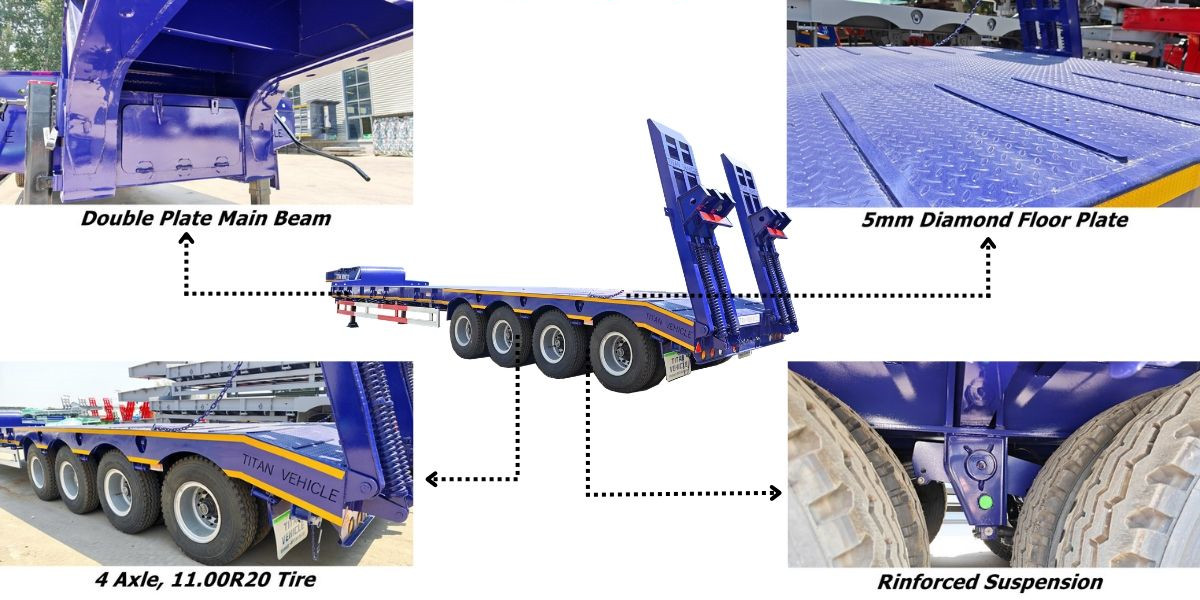
Axles, suspension systems, and tires are critical components that influence both the manufacturing cost and the long-term operating lowbed trailer price in Nigeria. Axles vary by brand, load capacity, and technical specifications, differing in terms of manufacturing processes, braking configurations, hub structures, bearing designs, and service life, which leads to variations in procurement costs.
Suspension systems generally fall into three categories: mechanical, air, and hydraulic. Mechanical suspension is relatively simple in design and easy to maintain, making it well-suited for standard construction machinery transport and cost-sensitive markets. Air suspension offers different vibration-damping characteristics compared to traditional leaf-spring suspension; however, it requires additional components such as air springs and control valves. Its suitability should be assessed based on load requirements and local regulatory standards.
5. Braking Systems and Safety Features
Since lowbed trailer used to transport heavy construction machinery, the configuration of the braking system significantly impacts both vehicle safety and cost. Common components include pneumatic braking systems, brake chambers, air lines, and air reservoirs. Depending on market requirements, these may also include features such as an Anti-lock Braking System (ABS). Braking components from different brands and with varying specifications may differ in terms of procurement cost, reliability, and ease of maintenance.
In addition to the basic braking system, some customers may request supplementary safety and electrical features, such as lighting systems that comply with local regulations, reflective markings, side and rear underride guards, or other safety-related accessories.
6. Vehicle Dimensions and Customization Requirements
Parameters such as the length, width, deck height, gooseneck dimensions, and ramp configuration also influence the final lowbed trailer price in Nigeria. Standard models typically utilize well-established design schemes and production processes, making their manufacturing costs relatively easy to control. However, if a customer requires a longer loading deck, a wider transport area, a lower deck height, or a specialized gooseneck design, it may be necessary to redesign the chassis frame, adjust the layout of the cross-members, incorporate structural reinforcements, or implement different suspension and tire configurations. Such modifications not only affect the quantity of materials required but also increase the workload associated with design, machining, welding, and assembly.